
Finding Kent County Residents
Kent County does not keep one master resident roll. The best starting record depends on the question. An address can lead to the county property search and then a parcel number. A person connected with a parcel can lead to a deed index. A current registration question belongs with Michigan's voter tools, while a historic household belongs in Grand Rapids Public Library directories and newspapers. Court and vital records are useful for specific events, but both have access limits. A result from one source is a lead, not a final answer about where a person lives.
For a countywide search, first identify the municipality shown by the address. Grand Rapids offices serve city material, while Kentwood, Wyoming, Walker, townships, villages, and rural areas may have their own assessor or clerk route. The county's parcel and mapping tools cover much of the geographic layer. The combined Clerk/Register, the Register of Deeds, Michigan agencies, and the library each hold different parts of the record trail.
- Enter a current address in Kent County Property Search and record the parcel identifier, municipality, and legal-description clues.
- Use the Kent GIS Public Viewer to check parcel geometry, address points, subdivisions, and nearby parcels.
- For an ownership change, move from the parcel to the Register of Deeds index and compare the instrument with its legal description.
- For a historic household, use the library's city directories, then test the old street number and surname in nearby years.
- When a needed non-exempt county record is not online, make a narrow Michigan FOIA request to the office that holds it.
Note: A parcel owner, a mailing address, and an occupant can be three different things, so use a second independent record before drawing a conclusion.
Kent County Parcel Search Clues
The county property form combines Treasurer and Equalization data. It offers address and parcel modes, and its address search is designed for a street number, a street name, an optional range, and a city, township, or village selection. It also distinguishes active and inactive parcels. The form uses a CAPTCHA, so an automated request will not open a parcel card. County search tips are practical: omit punctuation and street-type words, try a direction prefix and then omit it, and test numeric and spelled-out versions of numbered streets.
| County property field | Use | Search note |
|---|---|---|
| Street Number and Range | Locate one address or a segment | Ranges support a street-oriented starting point |
| Street Name | Find an address | Leave out Avenue, Street, and punctuation |
| City/Township/Village | Narrow the municipality | Choices were not exposed in the captured form |
| Parcel Status | Choose active or inactive parcel context | Verify current data with the local assessor |
| Parcel segments | Find a known parcel number | The county form divides the number into five inputs |
Values are reported on an assessment-cycle schedule, with the county noting March currency and April processing of later changes. The Grand Rapids BS&A lookup is a separate city-only option. It exposes Address, Name, and Parcel Number modes, then returns Address, Reference #, and property-owner Name. That makes it a useful city route, not a countywide name directory.
A Kent County Property Search screen shows the address and parcel route used for a current property inquiry.
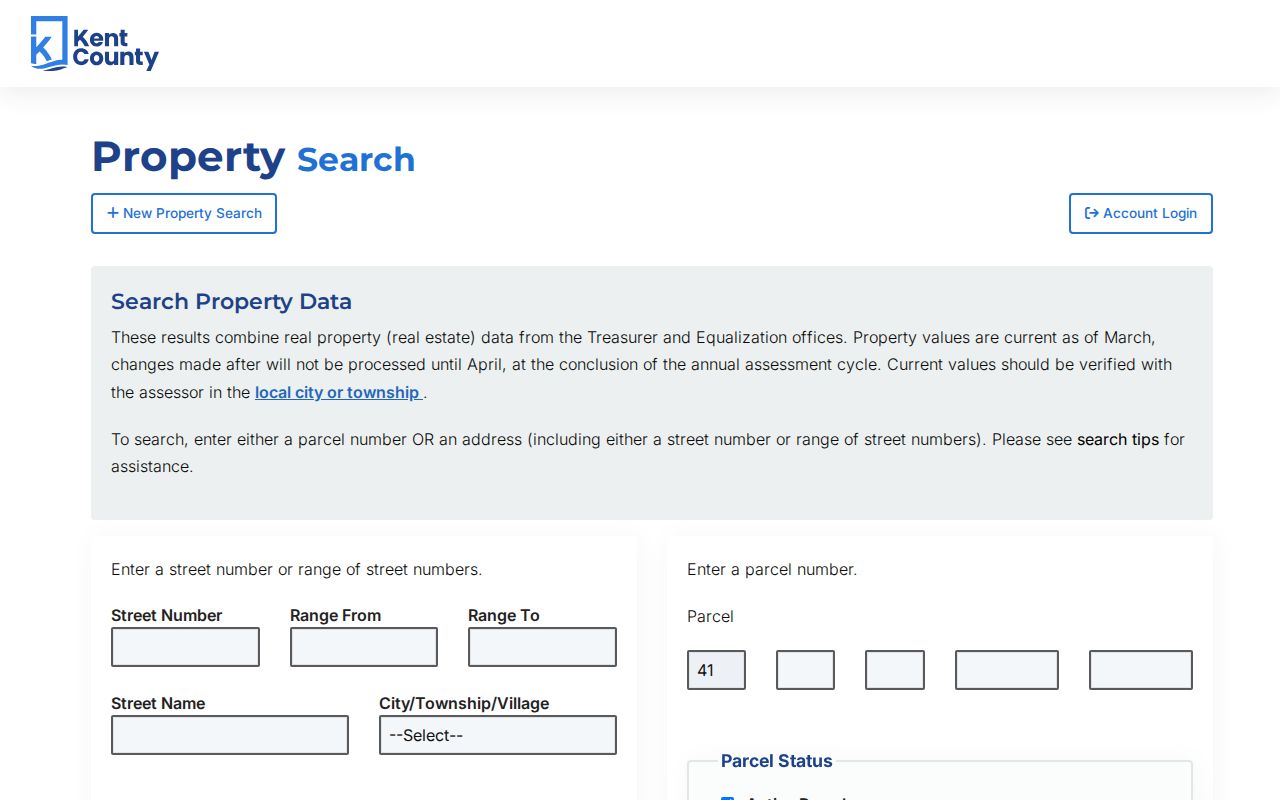
The form is most valuable for turning an address into a parcel-based record trail. It does not establish who occupies a property.
Kent County Resident Record Offices
The county's public-record offices are easier to use when their roles stay separate. The Register of Deeds holds land instruments. Equalization, GIS, and local assessors connect an address to a parcel. The Clerk/Register is the county route for vital records, elections, and many court-related services. The state layers add voter status, statewide vital copies, licensing, court resources, and other specialized systems. Each office can confirm a different fact, and none should be treated as a full current-resident list.
Kent County Register of Deeds
300 Monroe Avenue NW
Grand Rapids, MI 49503
616-632-7610
Equalization and Mapping
300 Monroe County Administration
Grand Rapids, MI 49503
616-632-7520
Kent Clerk/Register Elections
300 Monroe Avenue NW
Grand Rapids, MI 49503
616-632-7640
The Register of Deeds offers a free basic land-record index from January 1, 1970. It directs someone who does not know an owner to Equalization or a local assessor first. Copies can be requested at the office or in writing. The Clerk/Register issues certified county vital copies, maintains election functions, and provides access to Circuit Court files subject to legal restrictions. That division of work helps avoid asking one office for a record held by another.
Kent County Maps Before Names
GIS is a useful bridge between an address and the records indexed by parcel or legal description. The public viewer provides a Search for an Address box and shows Parcels, Subdivisions and Condos, and Address Points. Search one known address, zoom to its polygon, and note the neighboring parcel numbers before opening a property record for each. The map provides geographic context. It is not a legal survey and it does not prove who lives at the location.
- Parcel
- A numbered unit of land used in tax and mapping systems.
- Situs address
- The physical location of a property, which can differ from the owner's mailing address.
- Index
- A finding tool that points to a fuller record, such as a recorded deed.
- Criss-cross directory
- A directory section arranged by street and house number rather than surname.
This distinction matters in Kent County. An out-of-county owner, trust, corporation, or relative can receive tax mail at an address other than the parcel. The map and tax record may still be the right way to find a deed or a historic address, but they are not occupancy proof. For a whole named street, the Kent County by-street directory keeps the address chain together.
The Michigan Voter Information Center is a separate person and registration-status service, not a map layer or a public browse list for an entire block.
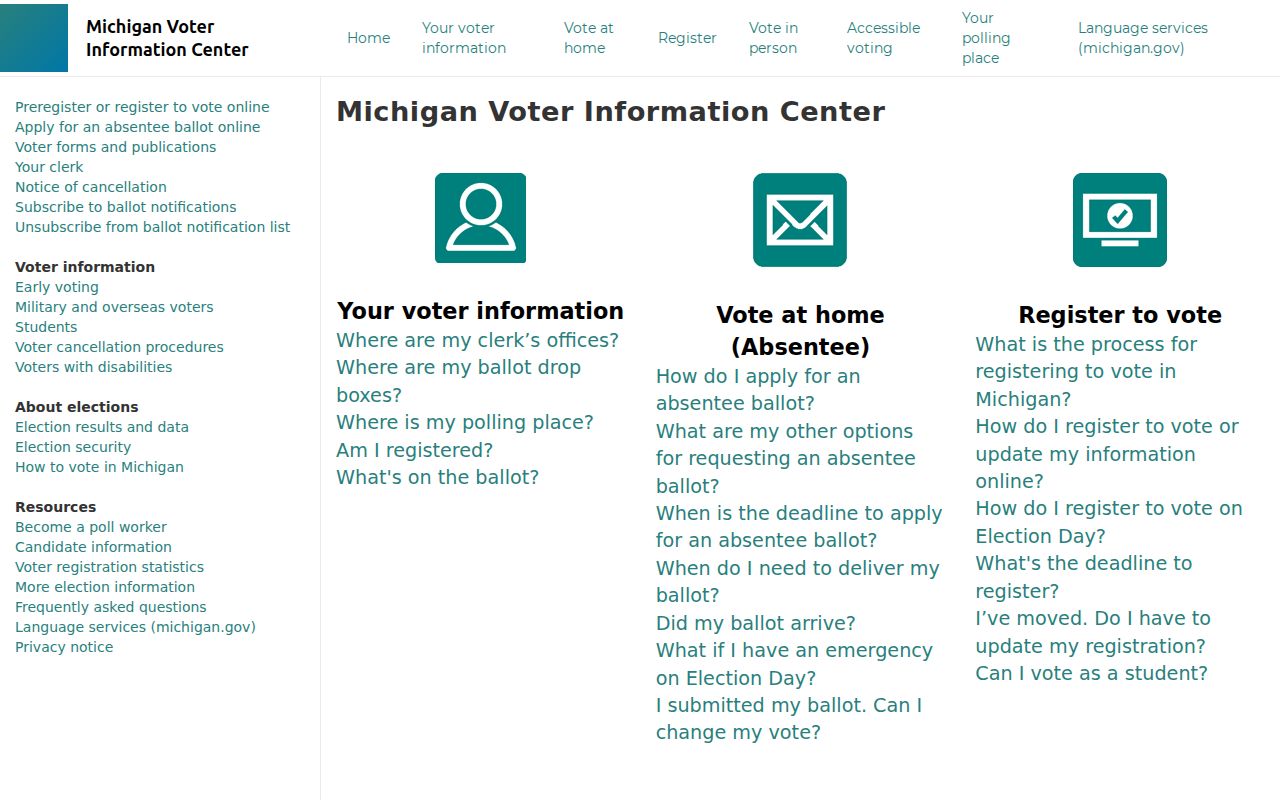
Use voter information only within its public rules and compare it with the correct municipality and another record type.
Current Kent County Resident Sources
Current directory-like sources describe different groups. Property records identify people associated with a parcel. A recorded instrument lists parties to a transaction. Michigan voter tools address registration and election information. Court, licensing, and business databases answer narrower questions. The useful habit is to record what a source actually confirms instead of treating every name as evidence of present residence.
| Current source | What it can confirm | Custodian | Access path |
|---|---|---|---|
| Property and tax record | Parcel, owner, values, address context | Kent Equalization/Treasurer or local assessor | County portal or municipal tool |
| Deed index | Grantor, grantee, document, date, legal-description pointer | Register of Deeds | Free basic index, with copy options |
| MVIC and voter records | Permitted registration and election information | Michigan Secretary of State and local clerks | Public lookup or lawful records route |
| Court records | Case involvement, docket status, and public filings | Kent courts and Michigan courts | Portal, clerk, inspection, or request |
| Professional license | Public license status and related fields where available | Michigan LARA | MiPLUS verification |
Michigan voter-registration records are subject to MCL 168.509gg. Month and day of birth, phone numbers, driver or state ID numbers, signatures, the last four Social Security digits, certain receiving-office data, and Address Confidentiality Program records are protected. A public record is still a redacted record. A fuller name-based verification sequence belongs in the Kent County resident lookup material.
Kent County Deed Index Limits
The online deed search is strongest when it follows a parcel trail. The basic index is free from January 1, 1970. Kent County's June 2026 notice lists $1 per page for downloaded or printed images, while advanced access is listed at $25 for 24 hours or $2,000 a year. The county warns that its index works like a library catalog. It points to an instrument, but it is not the instrument itself and the data can change.
Search a current owner as a grantee, read the instrument number and legal description, then search the prior grantor as an earlier grantee. Check trusts, estates, corporations, spouses, and spelling variants. Before 1970, the trail shifts to older books, ledgers, microfilm, tract books, and library or archive material. A deed party can be a former owner, lender, representative, or other transaction participant, not necessarily a resident.
The Kent County FOIA information page explains how to request non-exempt county records that do not appear in a public portal.
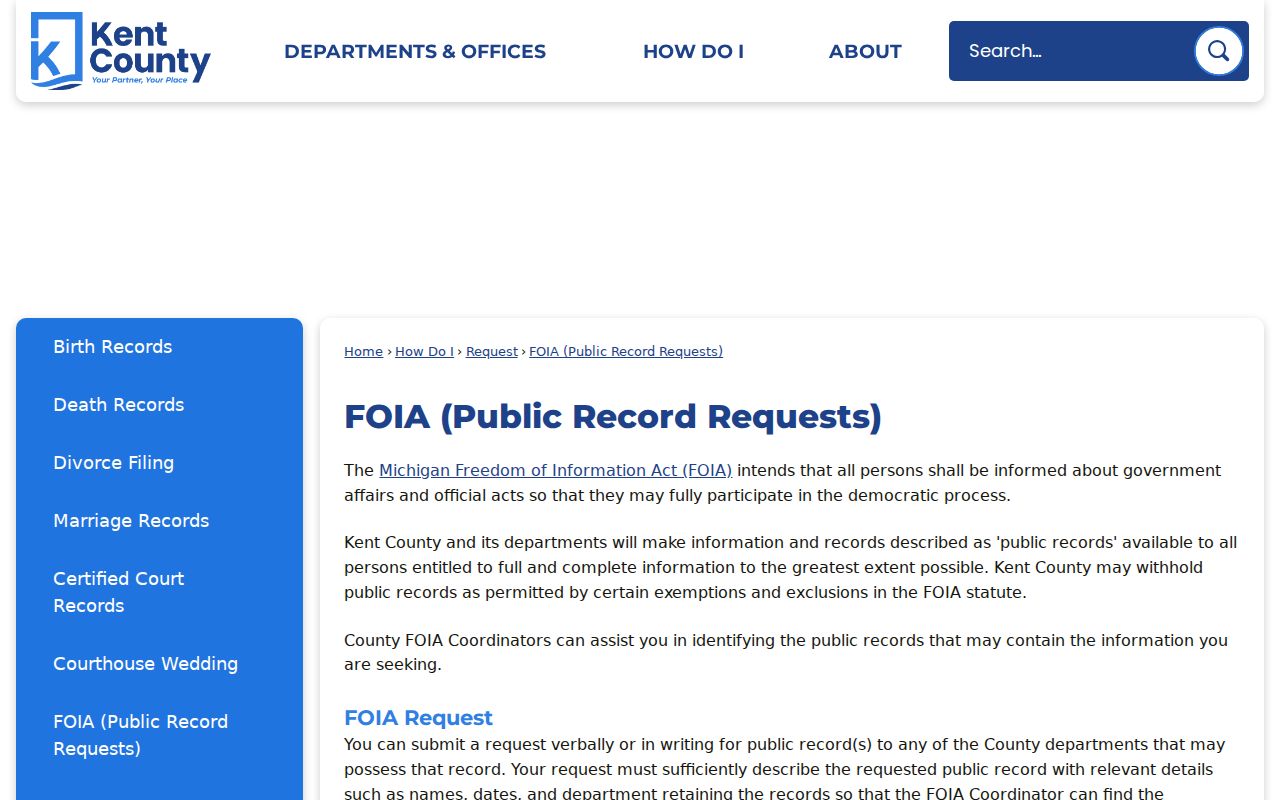
A focused request names the department, person or entity, date range, address, and record type, which gives the custodian a practical starting point.
Kent County Court and Vital Trails
A court result requires care. Kent's 17th Circuit route directs researchers to a name search, court resources, certified-record requests, and Clerk access. The Clerk says an online criminal name search requires a full name and date of birth. County materials conflict on history: one description says criminal records reach 1996 and civil records 1987, while another says current criminal web searching may be limited to cases back to 2018 until further notice. Confirm the live portal scope before treating a blank result as meaningful.
For family-history questions, Kent County birth certificates date from 1867, death certificates from 1867, and marriage certificates from 1845. Birth records less than 100 years old have eligibility restrictions under MCL 333.2882. County rules allow broad purchase of death and marriage certificates, subject to the certified-copy process. The county genealogy route searches a five-year window for a written request and asks for a name and event date, with an approximate date accepted.
The 17th Circuit Court page and the county genealogy page provide separate access channels when a name needs event or case context.
Kent County FOIA Fallbacks
Michigan FOIA, 1976 PA 442, MCL 15.231–15.246, lets a person other than an incarcerated person request non-exempt public records. Kent County accepts requests online, by mail, fax, hand delivery, or a verbal route. Electronic requests are treated as received one business day later. The request should identify the department, names, dates, and a clear record description. A standard response is due within five business days, with a written extension of up to ten more days.
Fees may cover search, examination, review, separation or redaction, copying, mailing, and a deposit when expected cost exceeds $50. The county notes an indigency-waiver route for the first $20 under its conditions. A request cannot open protected voter fields, a restricted birth record, protected court information, or motor-vehicle address data. It is a way to ask the correct custodian for an available record, not a replacement for an index.
Historic Kent County Resident Directories
Grand Rapids Public Library is the principal historical directory center for Kent County. Its collection includes Grand Rapids and Kent County city directories from 1856 to the present, as well as surrounding-area directories, yearbooks, and local history material. The History Center is on Level 4 of the Main Library. Its broader holdings include maps, photographs, clippings, family and neighborhood research, letters, and business material. In-person work is often the most economical way to use archival sources, while a request card can identify a collection, box, or folder for staff.
Directory entries can place a surname at a printed address, sometimes alongside a spouse, occupation, business, or owner and renter notation. A street section runs the other way, from street and number to resident or business. Those facts describe the year and coverage of the volume. They do not prove a modern address or that every household member appeared in print. The full collection, how to read its abbreviations, and digitized volumes are covered in the Kent County city directories.
The Kent 17th Circuit Court name-search resource is a separate official route when historical research turns up a case reference.
Official search screens are a starting point for a defined record category, while historic library sources add the older address and household layer.
Kent County's 1912 Address Bridge
Grand Rapids renumbered its streets in 1912. Earlier numbering used different reference lines, while the newer system used Fulton and Division as its baseline. Sanborn material can show new numbers at the top and old numbers at the bottom. The 1912 Polk guide and GRPL's annotated street index are the practical bridge tools. Record the old number, new number, street spelling, quadrant, cross street, and municipality before rejecting a directory, deed, or newspaper hit.
Street renames add another layer. The historical list includes changes such as First Avenue to Buckley and Third to Grant, but it is a finding aid rather than a current street register. Current renaming questions belong with Grand Rapids policy and 311. Address changes can also coincide with annexation or municipal-boundary changes, so verify the parcel municipality with GIS rather than relying on the postal city alone.
Note: An old street number that fails in a modern property form may be a numbering change, not evidence that the household or building record is absent.
Kent County Newspaper Resident Clues
Newspapers can add the family and neighborhood details that a parcel or directory does not carry. Grand Rapids Public Library provides the Grand Rapids Press digitally from 1893 to the present through NewsBank for cardholders. Its local collections also include microfilm and selected neighborhood runs. A 2025 library viewer improvement made some previously hard-to-search neighborhood papers available remotely, including titles such as the Herald, Creston News, and West Side News. Search with a surname plus an address, spouse, church, cemetery, or business term, then compare the date to the directory year.
For a death or family-history question, Grand Rapids city cemeteries add a separate evidence layer. The city lists maps and contact information for six municipal cemeteries, while obituaries, funeral notices, and probate files may identify relatives or a later estate trail. The research did not locate a single universal Kent County obituary index. That is a reason to use the newspaper, cemetery, library, and court routes together instead of assuming an absent web result closes the search.
Note: A newspaper notice or cemetery reference can support a historical identity trail, but it does not confirm a current Kent County residence.
Kent County Privacy and Scam Checks
Michigan's Address Confidentiality Program gives qualifying survivors a substitute address and mail forwarding under 2020 PA 301, MCL 780.851 et seq. Protected voter records are also withheld. Driver and motor-vehicle personal information is limited by the federal Driver's Privacy Protection Act. Correct a record through the office that holds it, using an instrument, case, parcel, or registration number. A request to suppress a compiled listing does not alter the original county record.
Kent County's free Fraud Notify service can alert a subscriber when a document records under a chosen personal, business, or trust name. The first-two-letter first-name option can catch spelling variants, but it can also produce false matches. An alert is not proof of fraud. Open the official instrument and contact the Register of Deeds. Likewise, Michigan Treasury says its unclaimed-property search and direct claim process are free, so an unsolicited demand for an advance payment deserves independent verification.