
Kent County City Directory Collections
Grand Rapids Public Library, or GRPL, is the main local shelf for Kent County historical directories. Its History Center holds Grand Rapids and Kent County runs from 1856 to the present, along with nearby-area volumes, yearbooks, and local-history material. A directory is an annual snapshot, not a complete roll of everyone who lived in a place. Still, it can preserve a name, street address, household notation, and business reference that helps connect a person to a particular year. The City Archives and the Historical Society add older material and a separate path when a GRPL catalog search is not enough.
| Collection | Years | Where Held | Access |
|---|---|---|---|
| Grand Rapids and Kent County directory holdings | 1856-present | GRPL History Center | Print, microfilm, and catalog records |
| R.L. Polk directories, Collection 301 | Late 1800s and later; 1912-1913 item cataloged | GRPL archival collection | More than 50 boxes; selected volumes online |
| Historical Society directory holdings | 1859-1933 | Grand Rapids Historical Society and HathiTrust | Research links and digitized volumes |
| Google Books Grand Rapids volumes | Examples include 1859, 1886, 1911, and 1924 | Google Books | Searchable or viewable selected volumes |
| Annotated 1912 street index | 1912 guide with later changes within 1927 boundaries | GRPL | In-library use |
Coverage is strong but not uniform. GRPL reports a collection continuing to the present, while the final printed year for every annual Grand Rapids run was not located in the research. Later telephone and city listings may take different forms. For an exact gap, use the catalog, the volume itself, and the staff-led request process rather than assuming that every year was issued or digitized.
Kent County Historical Directory Desk
The GRPL History Center is on Level 4 of the Main Library at 111 Library St NE in Grand Rapids. It keeps books, letters, scrapbooks, photographs, clippings, maps, family files, house files, neighborhood material, and business-history sources alongside the directory runs. Staff can help a researcher begin, but an archive request needs the researcher and contact information plus the collection, box, or folder. Onsite work is encouraged. Most visits are limited to one box or five folders, and oversize material can require up to three business days of preparation.
The History Center is a better starting place than a broad web search when a directory has an unclear publication year, a difficult street spelling, or a companion collection that is not online. Research queries can have a fee, while in-person use is the lower-cost route. A directory result also gains value when it is placed beside a map, clipping, yearbook, or neighborhood file from the same period.
GRPL's History and archival collections show the local setting for these Kent County shelves.
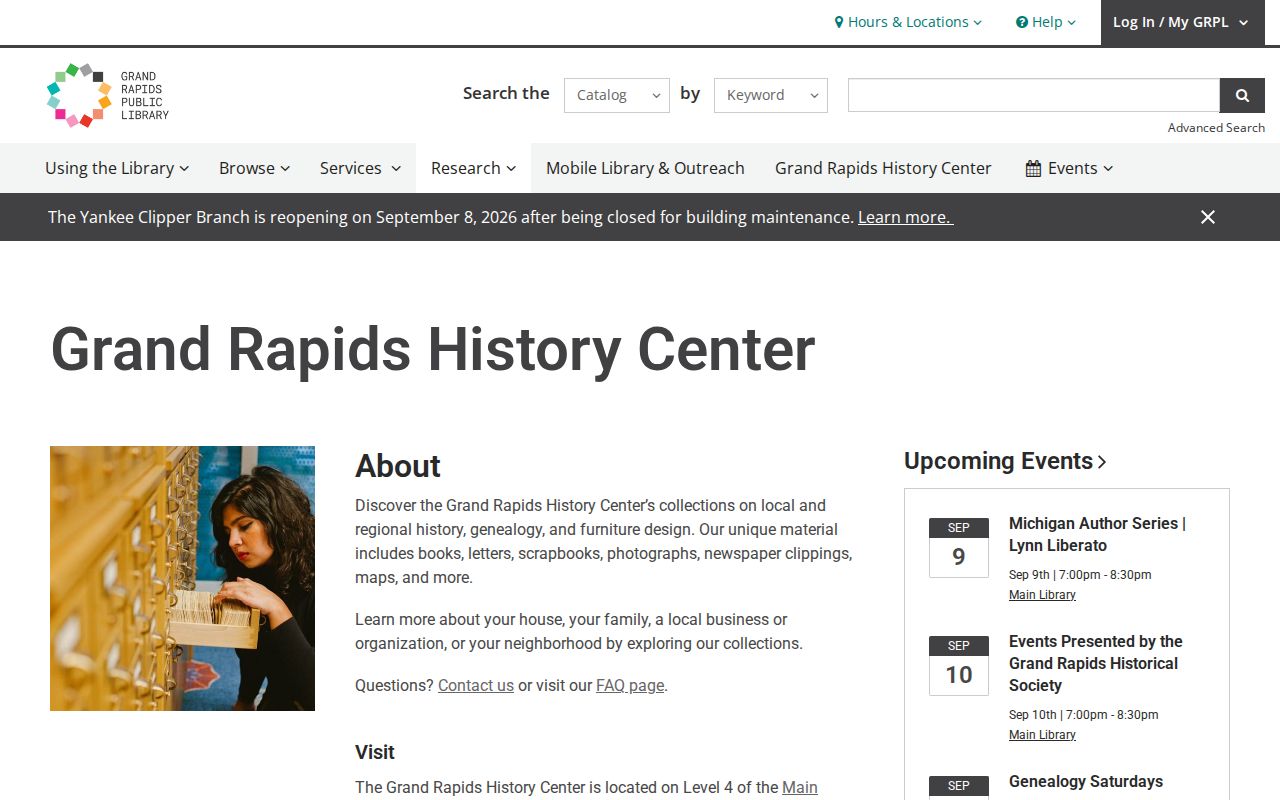
Use a finding aid before requesting archival boxes, then pair the selected volume with the street or surname question already in hand.
Kent County Directory Publishers
R.L. Polk is the most visible local publisher name, but it is not the only one represented in Michigan collections. GRPL's Collection 301, Grand Rapids Historical Business, City, and Telephone Directories, measures 29.1 linear feet across more than 50 boxes and covers Grand Rapids, Kent County, and Greater Grand Rapids. The cataloged Polk item for 1912-1913 contains the familiar alphabetic name section, street index, classified material, and publisher key. Its telephone material can help distinguish a household head or a business number in its own period, but it is not a current contact source.
The Library of Michigan guide also identifies late-1800s Polk runs, late-1960s Bresser material, and directories associated with Robinson, Norton, Johnson, W.C. Bailey, and Luedder. Formats vary. Some volumes add a surname list, numeric phone section, classified buyer's guide, picture advertisements, building directory, or notation for an arrival or relocation. That variety is why the key and front matter matter as much as the line containing a name.
The digitized Grand Rapids directory collection at Google Books provides a view of selected historical volumes.
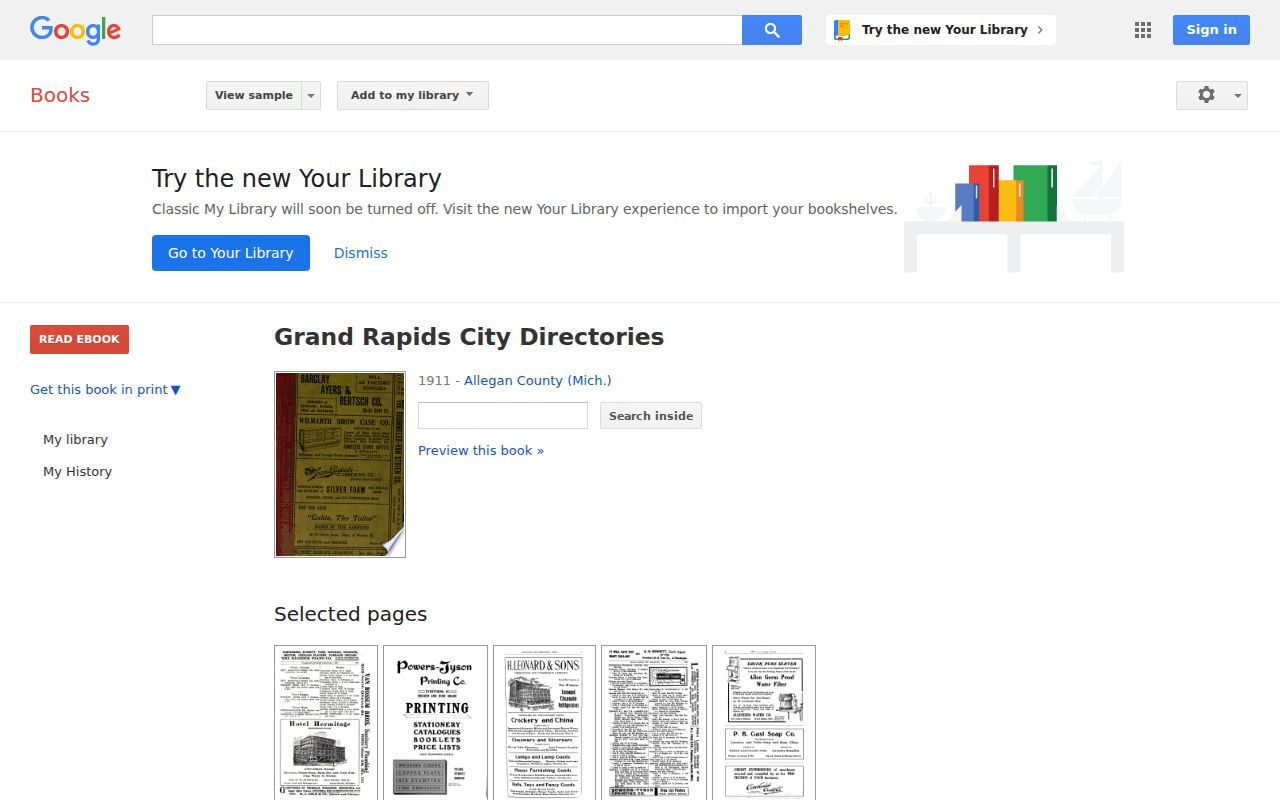
Inspect adjacent scanned pages and the abbreviation key, because a search result alone can omit the context needed to read a listing correctly.
Read a Kent County City Directory
Begin with the part of the book that fits the known fact. The alphabetic section begins with a person or family name. The street section runs alphabetically by street and then by house number. A numeric phone section, when one exists, generally points to the head of a household. A given line may include a spouse in parentheses, an address, a residence-status notation, a widow notation, or a trade or business reference. The exact symbols differ by publisher and year, so keep a copy of that volume's key with the transcription.
| Name | Usually the person or family indexed in the alphabetic section. |
|---|---|
| Household clue | A spouse, widow notation, boarding notation, or residence-status mark may appear. |
| Address | The house number and street can be checked in the street section. |
| Trade reference | Some lines add a business or trade detail that distinguishes similar names. |
| Publisher key | The front matter explains the abbreviations used in that edition. |
- Criss-cross directory
- A reverse section arranged from street and house number to the listed resident or business.
- Householder index
- A name-oriented part of a directory that can lead back to an address and household clue.
- Abbreviation key
- The publisher's explanation of symbols and shortened words, usually near the front of the volume.
Kent County Directory Number Bridge
Grand Rapids changed its street-numbering system in 1912. Fulton and Division became the baseline, and the 1912 Sanborn reference shows old and new number pairs as well as the even and odd sides of a street. A name can seem to vanish when the real problem is an old house number. Before rejecting a directory match, write down the old number, newer number, street name, cross street, quadrant, and any street rename.
- Before 1912: preserve the address exactly as printed in the directory or newspaper.
- 1912 guide: check the Polk street guide and GRPL's annotated index for the conversion and later notation.
- Map check: compare the result with a Sanborn sheet or plat before attaching it to a modern parcel.
- Later listings: search both number forms in nearby editions until the same household or street context confirms the bridge.
That local conversion is practical, not just historical. It can connect a former directory address to a present-day property trail without pretending that two similar street numbers are automatically the same place.
Trace a Kent County City Directory Household
For family history, work one edition at a time. Note the street spelling and printed number, then return to the alphabetic section for the same year. Search the year before and after an apparent move. Mark any residence-status notation, widow or boarder clue, business reference, or institution listing. These marks do not prove every member of a household, but a sequence of yearly entries can show a move that a decennial record cannot.
- Locate the earliest reliable surname or address entry and transcribe it with its year.
- Check the matching street section, then follow the same name or number through adjoining years.
- Test both address forms when the trail crosses the 1912 renumbering.
- Pair the sequence with the federal census available through the 72-year public-release rule, which supplies household context at a different interval.
- Use a newspaper, cemetery record, or probate file to test whether a disappearance reflects a move, death, or a listing gap.
An annual directory is city-focused. A census is decennial and household-focused. Neither cancels the other. Together, they provide a stronger date range and help avoid treating one printed line as a complete family record.
Kent County Directory News Clues
GRPL historical newspapers can extend a directory trail when a person changes address or disappears from a later volume. The Grand Rapids Press is available digitally from 1893 to the present through NewsBank for cardholders. The library also keeps microfilm for dailies, neighborhood papers, and special titles. Its free remote viewer includes neighborhood titles such as Herald, Burton Heights Record, Southwest Community Alliance, Madison Square Sun, Creston News, and West Side News, with runs reaching 1893-1963.
Search an obituary name with an address, spouse, church, cemetery, or service term. GRPL did not identify one universal public county obituary index, so the useful trail is distributed across newspaper databases, clippings, funeral notices, cemetery records, and the History Center. A newspaper item can narrow a date or neighborhood, but it still needs confirmation from the underlying record.
Kent County Directory Limits
A directory entry does not prove a present residence or a complete household. A person may have moved between annual editions, been left out, appeared under a different spelling, or lived outside that volume's geographic scope. Telephone sections commonly emphasize the head of household, and classified pages describe places or organizations rather than every person connected to them.
Research tip. Treat the entry as a dated lead, preserve the edition and page, then confirm the address with a second source before drawing a family conclusion.
For a backward address trail that combines old listings with deeds, maps, and household evidence, use the Kent County past residents resource after the directory year and number have been established.