
Kent County Previous Residents Sources
House history in Kent County works best as an era-by-era chain. The Register of Deeds supplies modern transfer pointers. GRPL and FamilySearch supply early land material. Grand Rapids archives add appraisal cards, tax rolls, permits, and maps for addresses in the city. Directories and newspapers add the household layer that a deed cannot provide. Each source answers a different question, so preserve the legal description and the address form used in the period before moving to the next row of the trail.
| Source | Years It Covers | Where Held | What It Shows |
|---|---|---|---|
| County online deed index | 1970-present | Kent County Register of Deeds online | Transfers, liens, mortgages, and instrument pointers |
| Early deed index | Circa 1841-1870 | GRPL microfilm and county historical trail | Early grantor-grantee pointers |
| Tract books and deed abstracts | 1830-1860 | FamilySearch and GRPL microfilm | Land descriptions, early transfers, and parcel context |
| GRPL directory collection | 1856-present collection | GRPL and selected digitized services | Address-to-household and name-to-address clues |
| Grand Rapids appraisal cards | 1936-2009 | City Archives and Assessor | Owner, legal description, structure evidence, and photographs |
| Grand Rapids tax rolls | 1860- | City Archives | Taxable-property trail and valuation context |
| City building permits | Circa 1978-1998 archived run | City Archives and Agency Counter | Work, dates, address, and a possible applicant |
| Sanborn fire maps | 1874, 1878, 1895, 1913, 1950, and 1952 editions | GRPL, Library of Congress, and Archives | Footprints, use, numbers, and nearby structures |
| Federal census | Decennial schedules through the 1950 public release | Census, NARA, and archival sources | Household context at a different interval |
| Newspapers and probate | Grand Rapids Press digital from 1893; case-dependent probate | GRPL and Kent court files | Death, move, relatives, representative, and address clues |
Begin with the current parcel when the address is modern and known. For an older Grand Rapids place, test the 1912 number bridge before assuming a directory or map has no match. The oldest segment often moves from online indexing to microfilm, books, and finding aids, not to a different name search.
Kent County Previous Residents Deed Chain
The property chain starts with a parcel, not a surname. Kent's Property Search accepts address and parcel modes, while the county GIS viewer can locate an address and show the related parcel geometry. Copy the current owner's name and legal description before using the deed index. A deed party may be a trust, estate, corporation, spouse, or administrator. That is why the legal description, lot and block, parcel splits, and instrument references must stay with every step.
- Locate the address in GIS or Property Search, then record the parcel number, current owner, and legal description.
- Search the current owner as a grantee in the Register of Deeds index to find the purchase instrument.
- Read that instrument for the grantor or seller, document number, date, and legal-description reference.
- Search that grantor as a grantee to identify the earlier acquisition, checking the same lot, block, subdivision, or description.
- Repeat the switch from seller to earlier buyer, testing entity names, spouses, estates, trusts, and spelling variations where the chain changes form.
- When the trail reaches the online boundary, continue through older ledgers, microfilm, tract books, abstracts, and GRPL or FamilySearch materials.
- Grantor / grantee
- The grantor transfers an interest in the instrument; the grantee receives it.
- Chain of title
- The sequence of recorded transfers that connects one interest in a parcel to an earlier one.
- Legal description
- The lot, block, subdivision, metes-and-bounds, or other land description used to identify the conveyed property.
- Criss-cross directory
- An address-first directory section that can identify a listed household or business at a printed number.
Kent County Previous Residents Before 1970
The county's free basic land-record search begins January 1, 1970. The Register of Deeds describes the index as a pointer to the underlying document, not the document itself. Current county information says downloaded or printed images are $1 per page by credit card, with convenience or handling fees. Advanced access is listed at $25 for 24 hours or $2,000 a year, with full index access back to January 1, 1970. Confirm the county page before relying on a fee, because the notice is dated June 22, 2026.
Earlier does not mean absent. GRPL identifies an early Kent deed index from about 1841 to 1870 on microfilm. FamilySearch and GRPL materials include tract books and deed abstracts for 1830 to 1860. These older aids point to the land and transfer history, but a researcher still needs to compare the legal description and the changing address rather than treating a shared surname as proof of the same parcel.
Index tip. Search spelling variants and alternate criteria, then open the underlying instrument and verify its legal description before placing it in the chain.
Kent County Previous Residents House History
GRPL's house-history guide gives Kent County researchers a practical sequence beyond deeds. It points to city directories, real-estate listing cards from the 1950s through the 1990s, assessor records, aerial photographs, Sanborn maps, deeds, plats, property maps, and local historic sources. For Grand Rapids addresses, historic real-property appraisal cards run from 1936 to 2009 and may show the owner, legal description, build date, structure details, or photograph. The guide also identifies aerials from 2003, 2009, 2014, and 2018.
Use these records as dated property evidence. An appraisal card may provide a bridge between a transfer and a structural change. A listing card can add a period description. An aerial or plat can help test whether the physical site matches the legal parcel. None of those sources alone establishes who lived there, which is why the household layer should be checked separately.
The GRPL house-history guide brings the directory, map, assessor, and deed trails into one local research path.
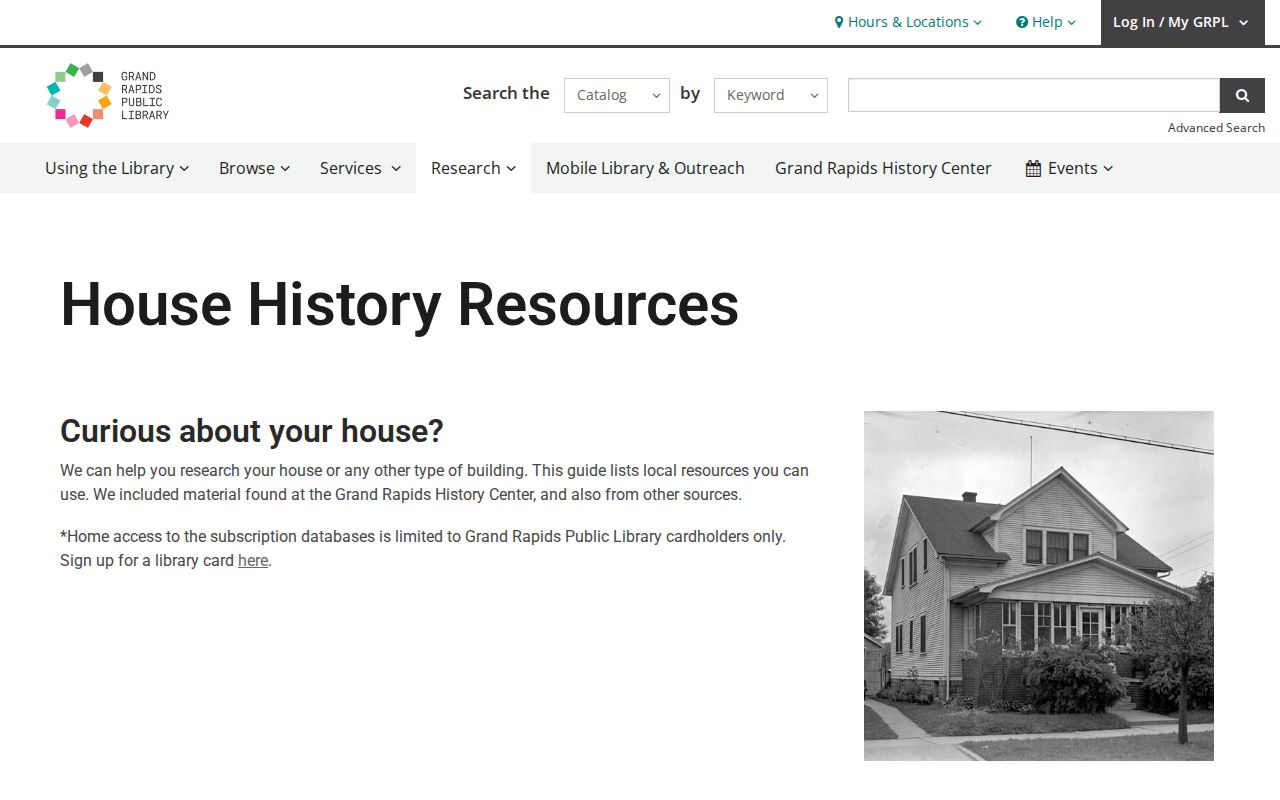
Follow the guide's record types in date order, keeping the parcel description beside each address form and map reference.
Kent County Previous Residents Number Bridge
Grand Rapids renumbered its streets in 1912. Fulton and Division became the baseline, and the 1912 Sanborn reference carries old and new numbers with the even and odd sides of the street. The Polk 1912 guide and GRPL's annotated street index are the local bridge tools. A record that seems to belong to a different house can be an older form of the same address, while a matching modern number can be the wrong location.
Write both numbers, the street name, cross street, quadrant, and any renamed street before searching an old directory, deed, map, cemetery notice, or newspaper item. Check the conversion against a Sanborn sheet or plat, then return to the parcel legal description. This step prevents a false break in the history of a home and is especially important when a household moves around the renumbering year.
Kent County Past Household Trail
People listed at an address and people named in a transfer are not necessarily the same. For past residents, use the printed address section of a directory to identify a household, then check the alphabetic section in the same edition. GRPL's holdings begin in 1856, and selected Google Books or HathiTrust volumes can help with individual years. The city directory collections themselves are described in the Kent County City Directories resource, while this trail keeps the focus on one address across time.
- Transcribe the exact address, street spelling, and printed number from the selected directory year.
- Convert the number first if the record is near or before the 1912 change.
- Read the street section for the number and then the alphabetic section for the listed name.
- Compare one directory year before and after an apparent move, noting household or widow clues without inferring an unlisted person.
- Pair the directory sequence with the available federal census schedule, which is decennial and household-focused rather than annual.
A census can establish household context, while the yearly volume can narrow the timing of a move. If a line vanishes, test the old and new address forms, a spelling variation, and adjacent editions before drawing a conclusion.
Kent County Past Resident Endpoints
Newspapers, cemetery records, and probate files can close a trail when a household stops appearing at an address. GRPL's historical newspaper resources include the Grand Rapids Press digital run from 1893 to the present through NewsBank for cardholders, plus microfilm for dailies, neighborhood papers, and special titles. The newer remote viewer contains selected neighborhood runs, but it does not make every microfilm issue or obituary indexable. Search with a name plus an address, spouse, church, cemetery, or service term.
Probate can add a personal representative, heir, filing, or final disposition when an estate reached Kent court files. A newspaper notice, cemetery record, or probate case is an endpoint clue, not automatic proof of a final address. Compare it with the directory date and parcel history before connecting it to the home.
The GRPL historical newspaper collection offers the local newspapers used to test a late move, death, or family connection.
Preserve the publication title, issue date, page, and address wording so the news item can be compared against other dated records.
Kent County Research Boundaries
Use historical address research for family history, estate or heir questions, house history, and personal curiosity. Keep protected information out of notes and treat an old listing as a record of its own date, not an invitation to contact a living person. Michigan's Address Confidentiality Program protects qualifying participants through a substitute address, and redacted voter and motor-vehicle information have separate limits.
Lawful use. Michigan's anti-stalking statute, MCL 750.411h, makes stalking a crime. Never use a prior-address trail to locate, harass, threaten, or harm a living person.
When a record appears wrong, contact the custodian shown on that record and cite the parcel, instrument, case, or registration number when requesting its correction route.